
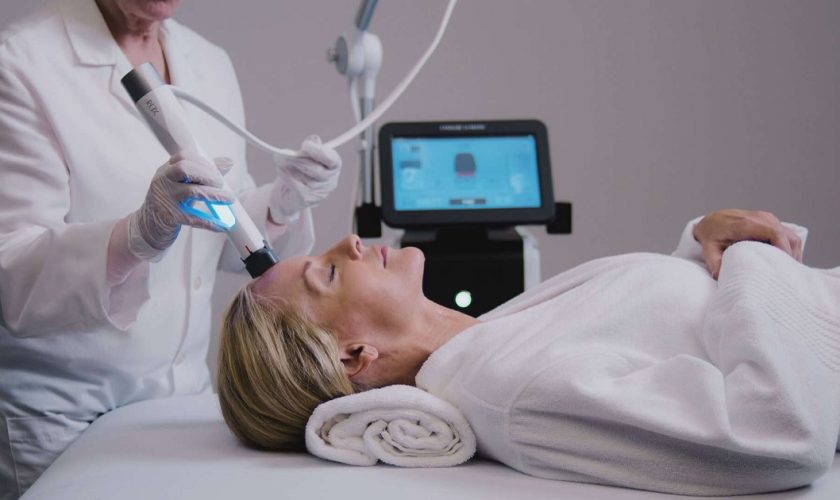
“XERF is a non-invasive, multifrequency monopolar RF lifting treatment that combines 6.78 MHz and 2 MHz radiofrequency to reach the deepest supportive layers of the face, targeting subcutaneous fat, SMAS, and anchoring ligaments to firm, lift, and rejuvenate skin from its deep foundation!”
- Did you know XERF is a truly customizable structural skin-tightening treatment, with three depth settings and ten intensity levels to better smooth and tighten, personalized for each patient?
- Did you know XERF skin tightening treatment targets multiple skin layers simultaneously? In contrast, traditional RF skin tightening uses a single frequency (usually around 6.78 MHz), and focuses primarily on the upper dermis for basic collagen proliferation.
- Did you know this advanced, no-downtime procedure, XERF, requires no numbing, injections, or healing time, and delivers energy not just deeper but exactly where you need it most, producing smoother, tighter, more rejuvenated skin?
- Did you know tradition radiofrequency skin tightening generally improves fine lines and mild surface laxity, but XERF reaches deep adipose tissues and fascial planes, providing deeper lifting and a defined jawline and neck contour without needles or surgery?
As trends shift over time, breakthroughs in science and technology each year have also changed aesthetic treatment, especially in the anti-aging space, sparking new conversations.
The best results-centric approach is one that focuses more on “how” than “why,” airing the cosmetic conversation in full detail, where cutting-edge technology is not merely a cost-accelerating factor but the most important driver of custom-tailored results. At ROXSpa Beverly Hills, Dr. Jay Calvert and the team deliver high-energy treatment safely, keeping pain minimal, with no downtime and no surface injury.
How Is XERF Different from Traditional Radiofrequency Skin Tightening?
For patients considering XERF treatment in Beverly Hills, XERF is a specific RF platform, not an alternative to RF itself.
Traditional radiofrequency skin tightening and XERF both use radiofrequency energy and share the same underlying science: delivering controlled electrical currents into the skin to generate heat. This heat creates a targeted micro-injury that accelerates the body’s natural healing response, leading to more production of new collagen and elastin over time. However, the key difference lies not in the type of radiofrequency energy used, but in how that energy is engineered and delivered to the skin and underlying tissues.
What is Traditional RF Skin Tightening?
RF skin tightening is a broad category that includes different types of radiofrequency devices and treatment approaches, with different configurations, including monopolar, bipolar, or multipolar RF, depending on the depth and type of skin concern. The electromagnetic waves used in RF heat targeted tissue, creating controlled micro-injuries that activate new collagen and elastin production. Moreover, controlled dermal heating can produce immediate collagen changes, followed by long-term remodeling and neocollagenesis, repairing tissue and rebuilding the skin’s structural matrix without damaging the surface.
Configurations of RF Devices:
Monopolar RF: Delivers energy through a single treatment tip that travels deep into the tissue, reaching depths of up to 20 mm depending on the settings. It is a gold-standard technique for lifting sagging skin around the jawline, neck, and brows (e.g., Thermage).
Bipolar RF: The depth of the energy is strictly limited to half the distance between two poles, focusing entirely on the skin’s surface and upper dermis. It is highly effective in treating early signs of aging, smoothing rough skin, and minimizing large pores.
Multipolar / Tripolar RF: It combines two or more active electrodes to distribute radiofrequency energy evenly, which heats both superficial and medium-depth layers of the skin. It is excellent for treating mild to moderate skin laxity on the face, neck, and jawline. It is often used on smaller body areas, such as the arms, abdomen, or thighs, to target superficial fat and smooth the skin.
Fractional RF: It delivers energy in micro-channels to create controlled microscopic wounds, which helps encourage a healing response while leaving surrounding tissue untouched. It allows deep collagen remodeling and simultaneous skin resurfacing with significantly less downtime than traditional ablative lasers.
Microneedling RF: Radiofrequency energy is combined with tiny needles to puncture the skin and deliver a pulse of RF thermal energy deep into the skin. The process accelerates the wound-healing response, promoting collagen Type I, Type III, and Elastin production to rejuvenate the skin from the inside out. It is highly effective in tightening the jawline, reducing turkey neck, and smoothing stubborn neck lines.
What Is XERF Skin Tightening?
XERF is an FDA-approved, multifrequency, monopolar radiofrequency system that combines 6.78 MHz and 2 MHz RF frequencies to target multiple skin layers effectively for precise, customized energy delivery. XERF is one of those rare technologies, originally developed in South Korea before expanding into the U.S. cosmetic treatment industry, that is truly transforming non-invasive anti-aging treatment and is now considered the next-generation non-surgical lifting. It uses real-time skin analysis to tailor energy delivery based on the patient’s skin thickness and laxity concerns. However, XERF allows cosmetic surgeon/ certified aestheticians to adjust frequencies, pulse technologies, and depth settings based on the patient’s facial anatomy and skin concerns. In addition, the XERF system incorporates cooling technology and more even energy distribution, making you feel more comfortable during the treatment session while stimulating the body’s own collagen.
XERF vs. Traditional RF: What Are the Main Differences?
“XERF is RF, but not all RF skin tightening is XERF.”
The fundamental differences between XERF and traditional RF skin tightening system lies on the way of delivering the RF energy, the combination of frequencies used, treatment customization, and, of course, the way energy is designed to reach different tissue depth is, because both XERF and RF work on radiofrequency energy, but they deploy it in a completely different fashion.
XERF is a dual-frequency, monopolar system, but Traditional RF may employ a single RF frequency or a different RF configuration:
XERF combines 6.78 MHz and 2 MHz frequencies, allowing energy to be delivered at different depths based on treatment needs. XERF uses 6.78 MHz to target the dermis, or the middle layer of the skin, to accelerate skin tightening and smoothing. Lower 2 MHz frequencies allow XERF to deliver energy deeper into the tissue, heating near the SMAS plane and generating a thermal effect that triggers deep-tissue contraction and collagen remodeling.
The 2 MHz setting helps address structural concerns like sagging jawlines, jowls, deep nasolabial folds, and mild-to-moderate skin laxity. Moreover, the 6.78 MHz frequencies are customized for those patients looking to improve superficial skin texture, smooth fine lines, shrink pores, and boost elasticity.
On the other hand, an RF system may use a single frequency or a different RF configuration to deliver energy at one set frequency. The RF system focuses its thermal energy primarily in the upper and mid-dermis to smooth fine lines and surface texture.
XERF is designed to improve structural skin tightening, while traditional RF primarily focuses on superficial skin remodeling:
The key differences between XERF and traditional RF devices lie in how deep the energy can reach and how the devices adapt to the shallow, middle, and deeper tissue levels. The XERF system uses a multi-tiered approach that dynamically adapts its energy profile to target the upper, middle, and deeper tissue layers simultaneously, acting like an automatic transmission for energy delivery. In contrast, traditional RF systems use a static approach that delivers a single, fixed frequency (usually 6.78 MHz) at a uniform depth, allowing practitioners to rely on manual energy adjustments to manage patient comfort and tissue resistance.
Note: Patients should understand that non-invasive RF treatments are designed to produce soft tissue tightening and collagen remodeling; it does not reposition facial tissues in the same way as a surgical facelift.
A custom-tailor treatment approach is an advanced attribute of the XERF system:
A treatment can be customized based on the patient’s age, aesthetic goals, skin profile, and treatment area, influencing the overall outcomes of non-surgical skin tightening. At ROXSpa, our expert providers create a highly individualized treatment plan by incorporating XERF’s accurate impedance feedback. This lets the practitioner perform real-time skin analysis and provides three depth settings and ten intensity levels to deliver energy that best suits your skin concerns and facial anatomy.
Traditional RF devices operate on a single frequency, which concentrates heat uniformly in the shallow to mid-dermis. However, if a patient has concerns of deep structural skin laxity, the conventional RF system cannot change its depth profile. Moreover, traditional RF systems rely entirely on the practitioner’s manual visual assessments to guess tissue characteristics, leaving too much room for human error and inconsistent results.
XERF can offer a more comfortable treatment experience:
Traditional RF devices may feel hot, pressuring, or slightly uncomfortable, depending on the device and treatment settings. But XERF incorporates Advanced Integrated Cryogen Delivery cooling technology, which helps control energy delivery while maintaining surface temperature, providing a warming sensation and a more comfortable experience. However, XERF does not require numbing, needles, or downtime, but the treatment experience may vary from patient to patient based on their personal pain threshold and specific skin anatomy. Because everyone has unique nerve sensitivity and tissue structure, XERF can provide a customized treatment plan to ensure optimal results, maximum safety, and a hassle-free experience.
Both Approaches rely on controlled thermal effects:
Despite differences between devices, both XERF and traditional RF systems rely on controlled radiofrequency energy to heat tissue, encourage a wound-healing response, and stimulate new collagen production and connective-tissue remodeling. However, XERF should not be considered a replacement for the fundamental science of radiofrequency skin tightening, but rather an advanced approach to delivering RF energy.
FAQs About XERF Skin Tightening Treatment
- Can XERF Replace a Facelift?
Absolutely not. XERF is designed to produce soft tissue tightening and ongoing collagen rebuilding for improved firmness and texture; it does not reposition facial tissue, which only a surgical facelift can achieve. The type of treatment recommended, whether surgical or non-surgical, depends on the patient’s aging status, skin anatomy, age, and treatment goals; however, an in-person consultation with a board-certified cosmetic surgeon is essential before considering any anti-aging option that best fits your goals. Moreover, patients with mild to moderate skin laxity may be recommended for a non-invasive skin-tightening option. Still, those dealing with significant jowling, substantial excess skin, or more advanced facial aging may find surgical facelifting the right choice to achieve the desired level of correction and a more rejuvenated appearance.
- Who May Be a Candidate for XERF?
Patients with mild to moderate skin laxity and aging concerns in the face, jawline, lower face, and neck who want a non-surgical approach to facial rejuvenation are a good fit for XERF skin tightening treatment.
Candidacy criteria to get a recommendation for XERF may include:
- One who wants structural lifting and refinement without going under the knife, or one who cannot commit to the downtime or side effects associated with surgical procedures during healing.
- Patients in their 30s and 60s, as their skin still has a strong cellular capacity to produce a rich collagen response.
- Post-weight-loss patients who have reached their goal weight but now have saggy, loose skin around the lower face, cheeks, or jawline.
- Younger patients who want to proactively delay signs of aging, or those who have had previous facial rejuvenation surgery and want to maintain their structural lift over time.
- Is XERF the Same as Thermage?
No, although both use monopolar RF technology, they are different systems. In one hand, Thermage FLX is a predicate device. It lists different technical characteristics, including energy and frequency parameters; on the other hand, XERF incorporates its own technology, frequencies, treatment settings, cooling system, and delivery approach.
- Is XERF Safe?
XERF is an FDA-approved, advanced multifrequency monopolar RF skin-tightening system, meaning the device has FDA clearance and a guarantee of specific cosmetic outcomes. XERF received FDA 510(k) clearance in 2025. As with any energy-based medical device, appropriate patient selection matters, and a provider’s expertise and certification matter most for a safe, result-focused treatment experience.
For patients in Beverly Hills and Newport Beach, Southern California, considering XERF, it is mandatory to discuss your treatment goals and have your skin and aging status evaluated by a board-certified cosmetic surgeon to determine whether a non-surgical RF skin tightening approach or a surgical facelift is more appropriate based on your case or degree of facial aging to be addressed.
Call today at 310.777.8800 or 949.644.2858 to book your consultation.